Why Your Eyes Need Time in the Dark
Adapted · C1 · Graded story · 1:46 · C1 · AI-generated learning content
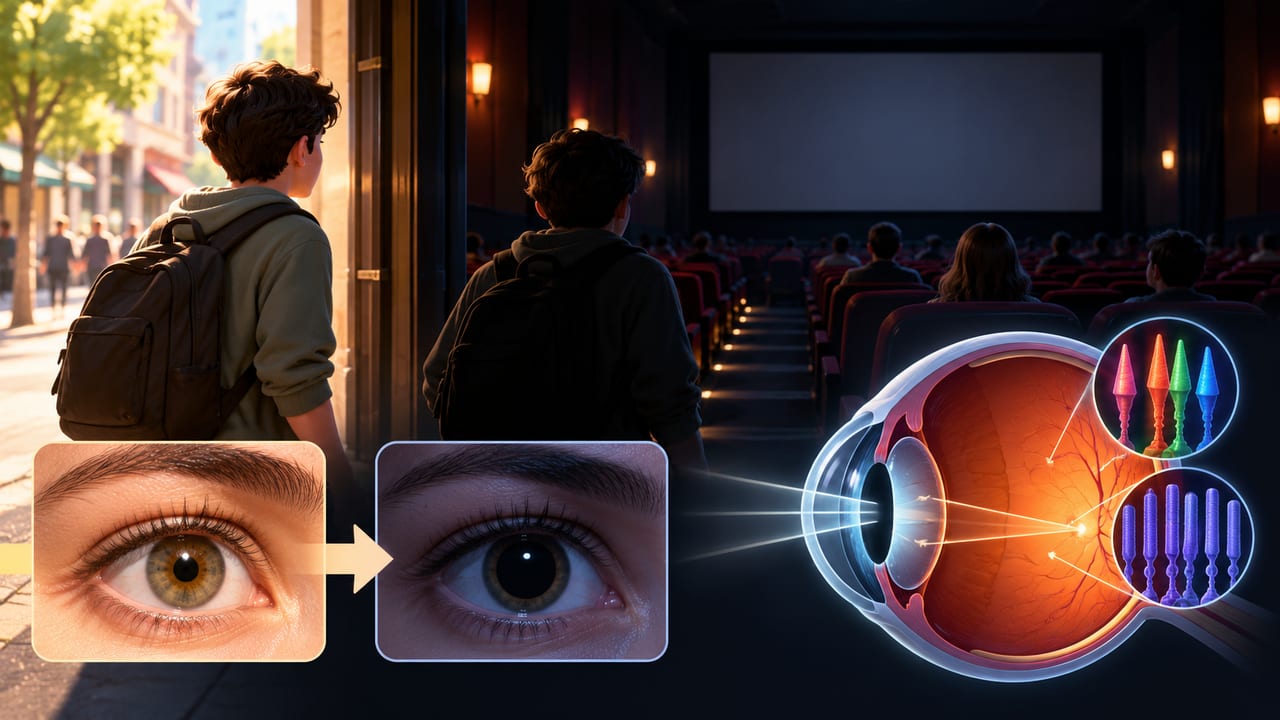
Walk from a sunny street into a dark cinema, and the seats may seem to disappear. A little later, you can make out rows, coats, and faces. The room has not become brighter. Your eyes have become more sensitive to the small amount of light available.
Part of this change happens at the pupil, the dark opening at the front of each eye. Muscles around it control its size. In bright conditions, the pupil becomes smaller. In darkness, it widens, allowing more light to enter. This happens fairly quickly, but it is only part of the explanation.
At the back of the eye is the retina, a thin layer containing cells that respond to light. Cones are cells that work best in brighter light and help us see colors and fine details. Rods are cells that are much more sensitive in low light but do not provide color vision. This is why a colorful garden can look mostly gray at night.
These cells use special light-sensitive chemicals to start signals that travel to the brain. Light changes the chemicals, and the eye must restore them before they can be used again. After exposure to bright light, rods need time to regain their high sensitivity. This adjustment is slower than the change in pupil size, and full adjustment to darkness can take many minutes.
The amount of light you saw before entering a dark place also matters. After strong sunlight, the change can feel greater than after sitting in a softly lit room. A bright light can interrupt the adjustment, too.
Night vision is therefore not a single switch. It develops gradually through changes in both the eye's opening and its light-sensitive cells. Even after adjusting, our eyes still need some light: they cannot show us a room in complete darkness.
Comments
0Share what you noticed, understood, or still find difficult in this article.