Why Skaters Spin Faster with Their Arms In
Adapted · C1 · Graded story · 1:48 · C1 · AI-generated learning content
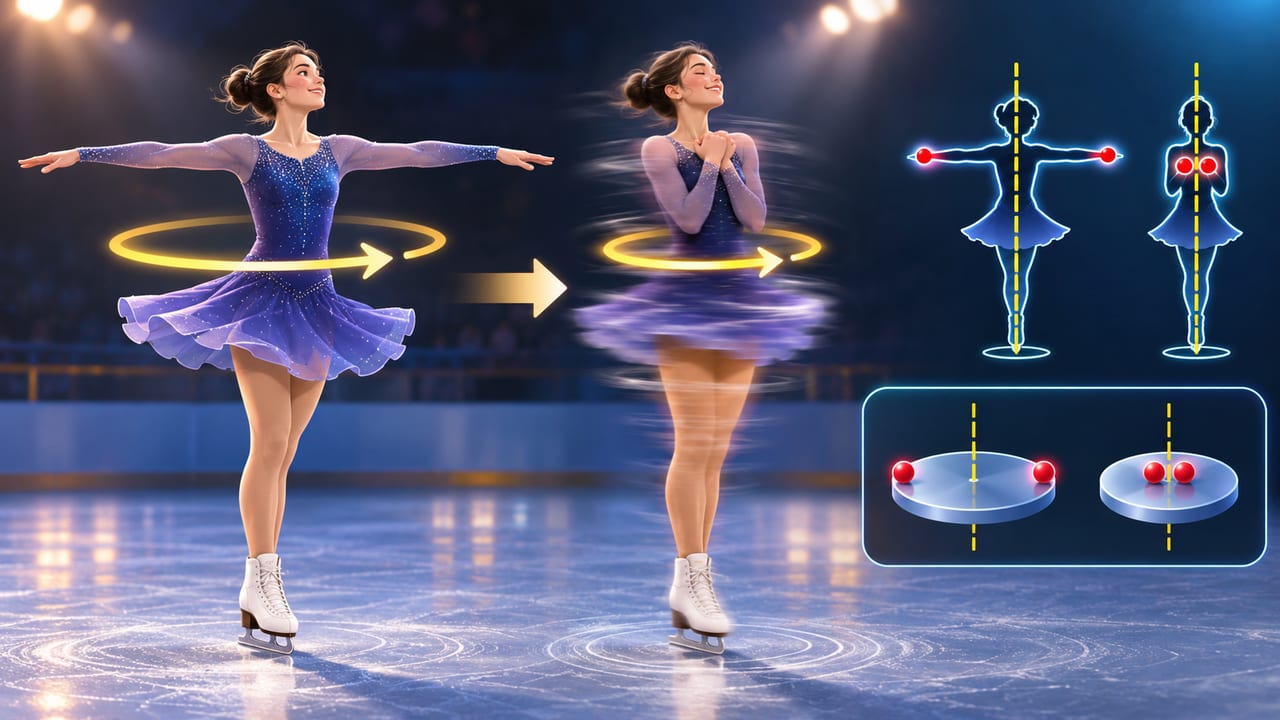
An ice skater begins a spin with both arms stretched out. Then the arms move toward the chest, and the spin becomes faster. The skater has not pushed against the ice again. So where does the extra speed come from?
The answer involves how the body's mass is arranged around the axis of rotation—the imaginary line around which it turns. In an upright spin, this line runs through the skater from head to foot. With arms extended, more of the body's mass is far from the axis. Pulling the arms in brings that mass closer.
Mass farther from the axis makes an object harder to speed up or slow down as it turns. This resistance to changes in turning motion is called moment of inertia. Pulling the arms inward reduces it. The skater's total mass stays the same; only its distribution changes.
Another important idea is angular momentum, a measure of turning motion. When there is little outside twisting force, angular momentum remains nearly constant. As the skater's moment of inertia decreases, the spin becomes faster. Stretching the arms out has the opposite effect: the spin slows.
This does not mean that faster movement costs no energy. Pulling the arms inward during a spin takes muscular effort. That effort adds energy to the turning motion, even while angular momentum remains nearly unchanged. Air resistance and friction also mean that a real spin cannot continue forever.
Divers use the same principle in the air. A body pulled into a tight shape can turn faster than an extended one. Opening the body slows the turning before entering the water.
These movements show why sporting skill is not simply about strength. Athletes also control where their mass is. A small change in body shape can produce a large, visible change in movement.
Comments
0Share what you noticed, understood, or still find difficult in this article.