The Roman Objects with No Clear Purpose
Adapted · C1 · Graded story · 1:53 · C1 · AI-generated learning content
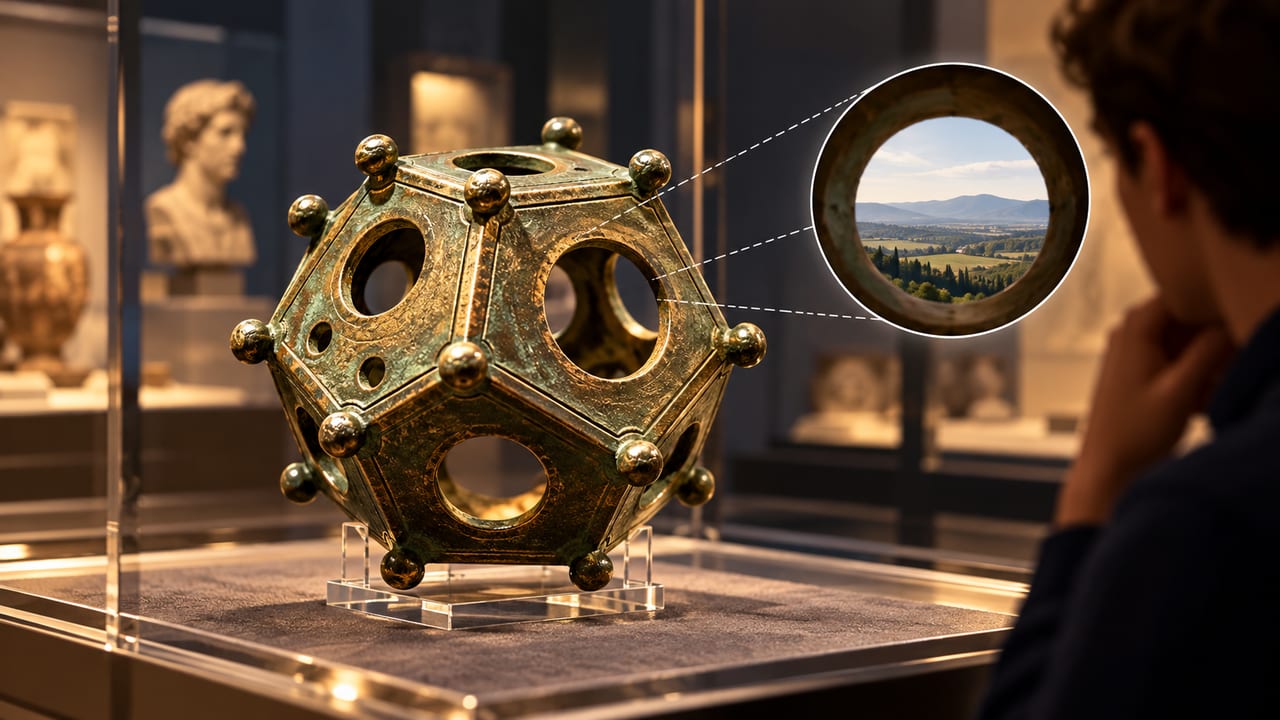
A small metal object sits in a museum case. It has twelve flat faces, round holes of different sizes, and small knobs at its corners. It looks carefully designed, but its purpose remains uncertain. This is a Roman dodecahedron, a hollow object with twelve flat faces.
Examples have been found in parts of Europe that once belonged to the Roman Empire, especially in the north and west. They are usually made from a copper-based metal, but their dimensions vary. No surviving written explanation has been confidently linked to them.
One proposed explanation is that they were measuring tools. Looking through two opposite holes could give someone a particular view of a distant object. In principle, this might help them judge distance if they knew the object's size. The carefully shaped holes make this idea worth considering. Yet the objects have no clear measurement marks, and their different sizes make it harder to establish a shared measuring system. A possible use is not a proven one.
Another suggestion connects them with making things from thread. Modern experiments show that people can use the knobs to make knitted tubes. This visibly demonstrates that the object can perform a useful task. However, a successful modern experiment does not establish what a Roman craft worker actually did. Stronger evidence would include matching ancient fabrics or a clear image of the object in use.
The difficulty is not a lack of imagination, but a lack of evidence that clearly distinguishes between the explanations. An object's shape can suggest several uses, while the place where it was found may reveal only part of its story.
For now, the purpose of these Roman objects remains unresolved. Their mystery highlights an important difference between asking,"Could this work?" and asking,"Is this what people really used it for?"
Comments
0Share what you noticed, understood, or still find difficult in this article.