Is the Bigger Bag Really Cheaper?
Adapted · C2 · Graded story · 1:52 · C2 · AI-generated learning content
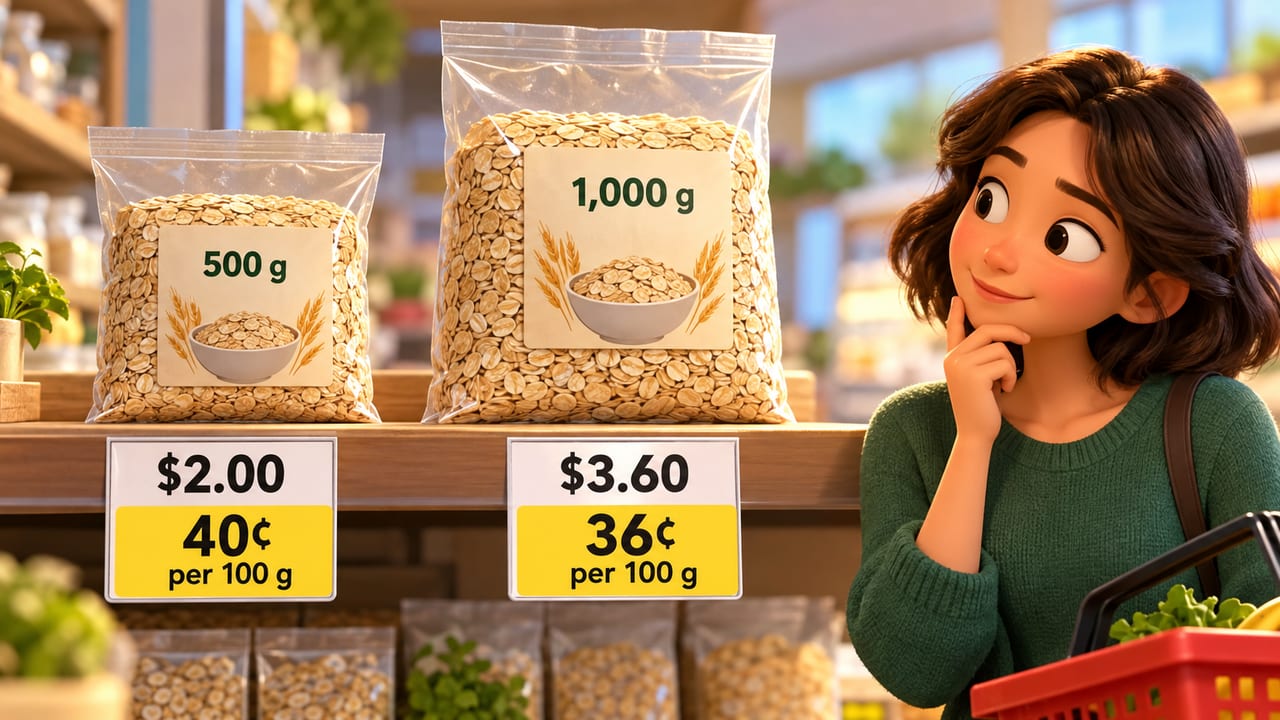
Two bags of oats sit on a shop shelf. One costs$ 2; the other,$ 3.60. Which is the better buy? Price alone cannot tell you. You also need to know how much each bag contains—and how much you will actually use.
The smaller bag holds 500 grams, while the larger holds 1,000 grams. To compare them fairly, calculate the price for the same quantity. Per 100 grams, the small bag costs 40 cents and the large bag 36 cents. The larger bag therefore costs less per gram, even though you pay more at the checkout.
This is the unit price: the cost of a fixed quantity. Some shops display it on the shelf label. If they do not, divide the price by the quantity, then multiply by a useful number, such as 100, to find the cost per 100 grams. There is no need to calculate this for every item; it is most useful when different package sizes make the choice unclear.
Check the units carefully. A price per kilogram cannot be compared directly with a price per 100 grams. Compare similar products, too: plain oats and a mixture containing nuts are not exactly the same food.
Next, consider waste. Suppose a 200-gram bag of fresh salad costs$ 2, while a 400-gram bag costs$ 3. The larger bag is cheaper by weight. But if you eat only half before the rest goes bad, you have paid$ 3 for the same amount you could have bought for$ 2.
Storage space and your available money also matter. A large bag may offer good value but leave little room in your cupboard or cost more than you can spend today. Special offers may come with conditions, so read the label before deciding.
The useful question is not simply,"Which package is cheapest?" It is,"Which choice gives me what I need, at a fair price, without buying too much?"
Comments
0Share what you noticed, understood, or still find difficult in this article.